Valencia:

The port city of Valencia is located on the southeast coast of Spain, where the Turia River meets the Mediterranean Sea. It is famous for the City of Arts and Sciences, with futuristic structures such as the planetarium, the oceanarium, and an interactive museum. Valencia also has several beaches, including some within the nearby Parque de la Albufera, a wetland reserve with a lake and trails.
 History:

Ecology:
Valencia contains an abundant flora, fauna, urban beaches, the garden, natural spaces made up of the Albufera, the garden, urban beaches, and the Rafalell and Vistabella marsh.
Recommended places to visit in Valencia:
-City of Arts and Sciences
-Monforte Gardens
-Albufera
-Jewish house
-The Silk Market
-The Micalet
-Central Market
-The Round Square
-The bank of Valencia
-The square of the Virgin
Flag of Valencia:
 The so-called Real Señera, Señera Coronada, or Señera tricolor, is the same flag as that of the Valencian Community. [42] The origin of this flag comes from a heraldic ensign, that is, a shield, which evolved until it took the form of a flag, with a crown on the bars of the kings of the Crown of Aragon. [43] In this way, currently the flag of the city is established as follows: «The Flag of Valencia is the traditional" Señera "composed of four red bars on a yellow background, crowned by having the title of Kingdom and a blue stripe next to the flagpole."
Main Festivity:
st Sunday of February with the act of the crida (in Valencian; 'pregón o llama', in Spanish).
Currently, this festival has become a very important tourist attraction, since in addition to being classified as a festival of International Tourist Interest, in November 2016 Unesco inscribed them on its Representative List of the Intangible Cultural Heritage of Humanity. [1] These festivals are also called Josephine festivals or festes de Sant Josep (in Valencian), as they are celebrated in honor of Saint Joseph, patron saint of carpenters, who was a very widespread guild in the city when they began to be celebrated at the end of the century. XIX, and that it has kept until today, given the importance of the furniture industry in the region.
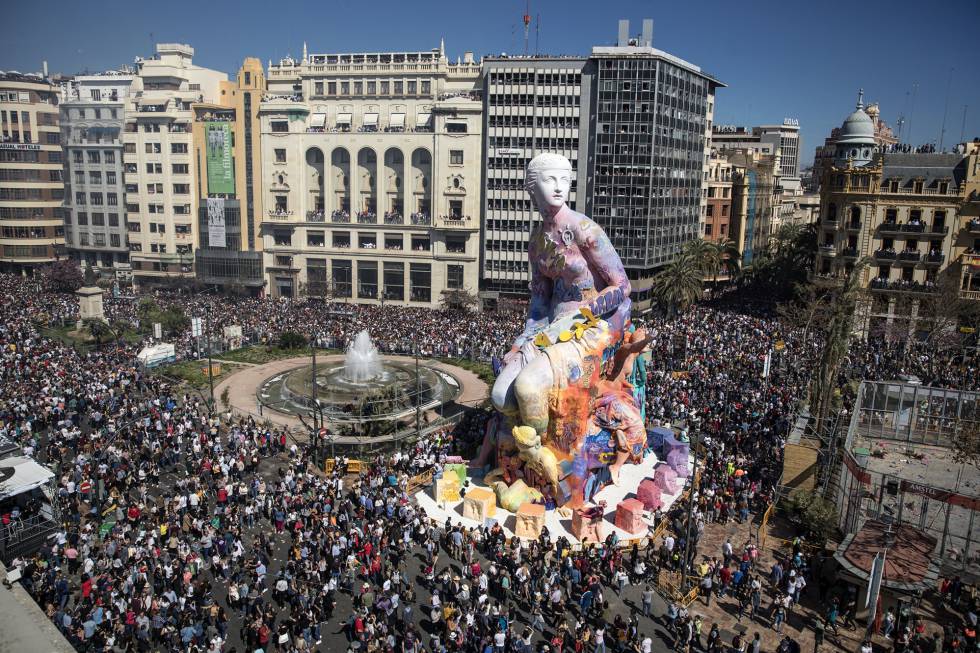
 The mascletà: This act takes place every day at 2:00 pm, from March 1 to 19. The name of Mascletá comes from a type of firecracker, the masclet. It is one of the most valued acts by Valencians, although it is also an act that visitors least understand, since to understand them it is necessary to be close to the place where the pyrotechnic products are exploited, since it is not a matter of seeing, but of feeling and hear, as they produce sensations similar to hearing a concert, making the noise envelop, and all in a matter of a few minutes (6-7) and reaching over 120 decibels.
They are basically made up of terrestrial material and an aerial beginning and end.


No hay comentarios:
Publicar un comentario